
Your cat just bolted out the front door. Again. You grab your phone, open the tracking app, and… nothing. No signal. No location. Just a spinning wheel and rising panic.
This is the moment that separates good pet trackers from expensive paperweights. When it comes to GPS vs Bluetooth pet trackers, the technology choice matters more than the brand — they solve completely different problems.
After a decade inside consumer electronics supply chains, I’ve torn down enough pet trackers to spot the marketing fluff. Let’s cut through the noise and figure out which technology actually works for your specific situation — not some generic “GPS vs Bluetooth pet trackers” “best of” list.
⚡ TL;DR: The Technology Split
Stop asking “which tracker is best” and start asking “what does my pet actually need?”
GPS Pet Trackers
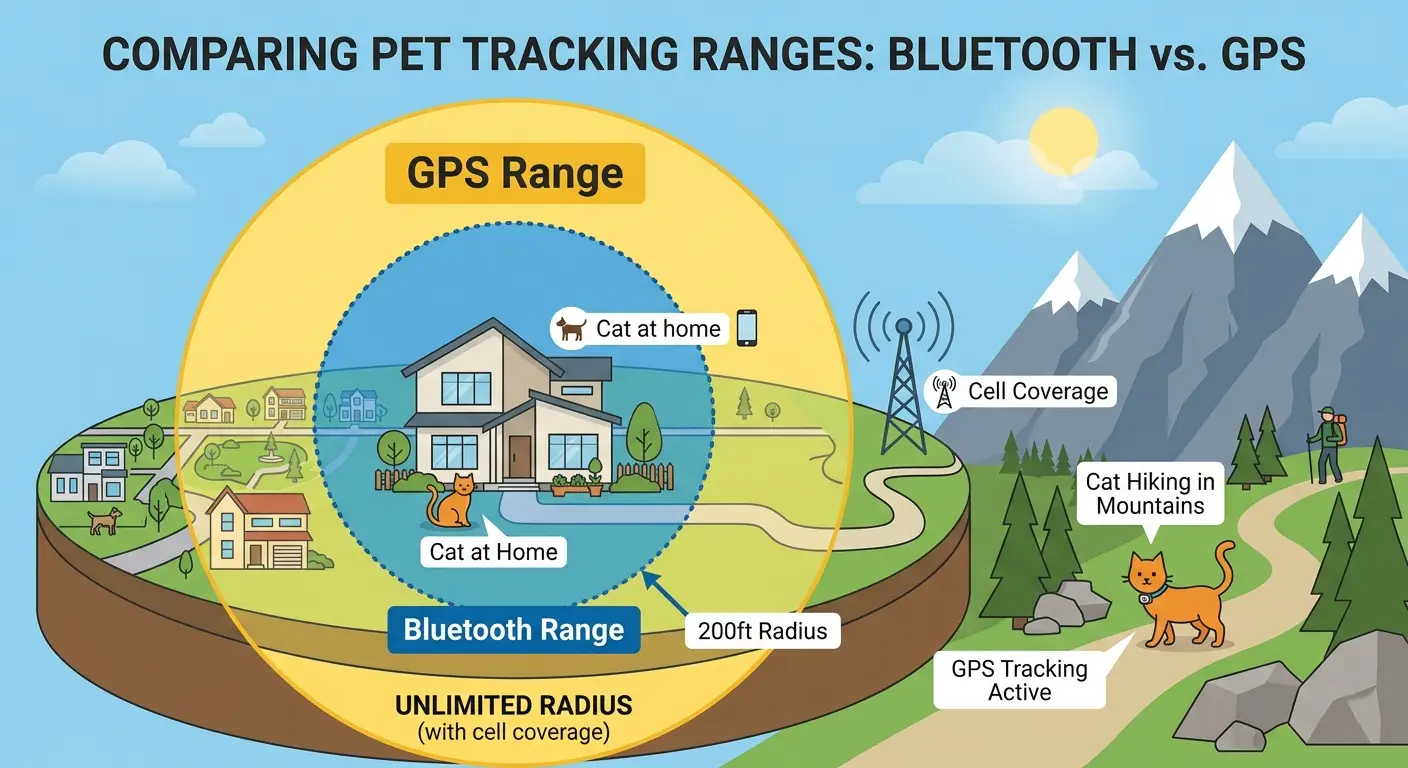
Best for: Dogs that hike, escape artists, pets that roam beyond your neighborhood. Unlimited range (with cell coverage), real-time tracking, works anywhere there’s a cell signal. Trade-off: Monthly subscription ($5-10/month) and larger physical size.
Bluetooth Pet Trackers
Best for: Indoor cats, dogs that stay close to home, apartment pets. 200-400ft range, no monthly fees, tiny form factor. Trade-off: Only works when other phones pass nearby (Apple Find My / Google Find My Device network).
What’s in this Guide:
Part 1: How They Actually Work (Hardware Teardown)
Before you drop money on a tracker, understand what’s inside. The technology gap between GPS and Bluetooth isn’t just features — it’s fundamental architecture.

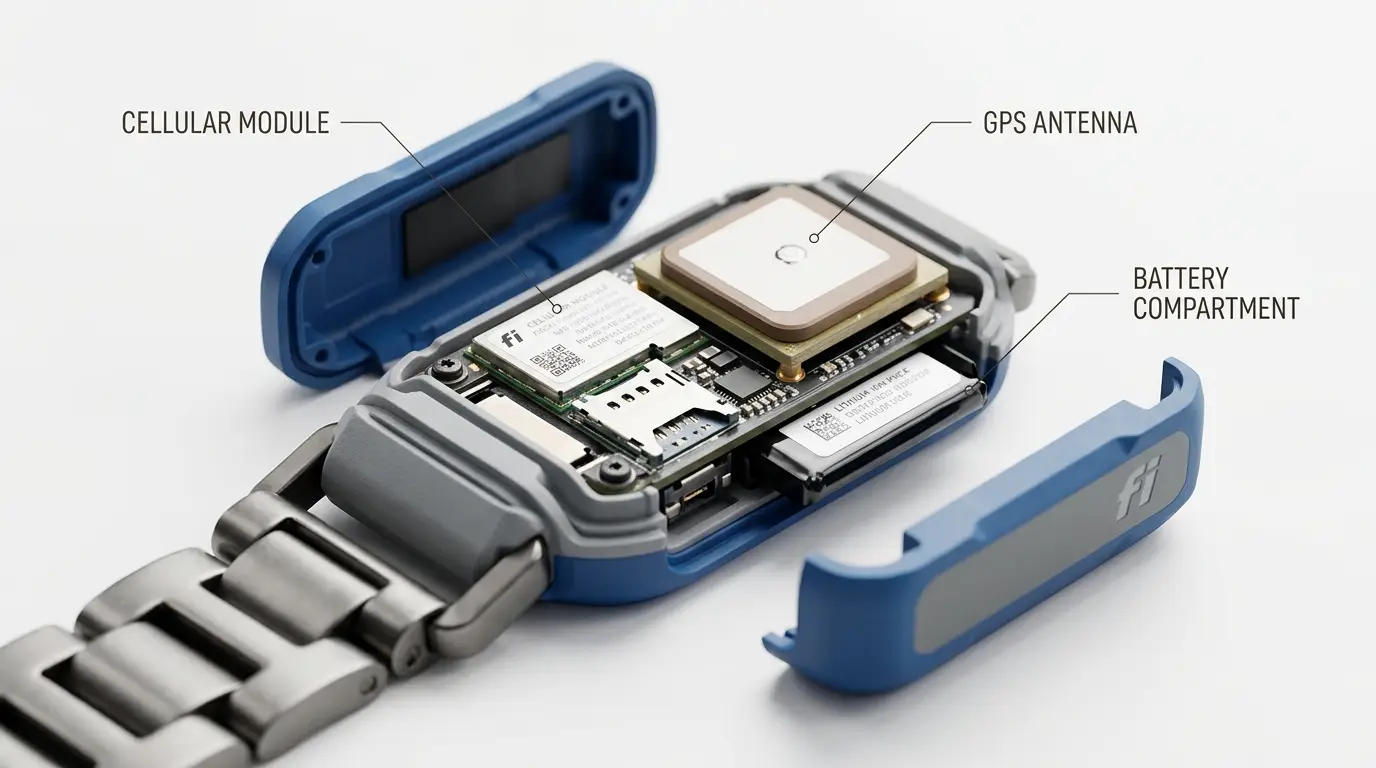
GPS Pet Trackers: The Satellite + Cellular Combo
A GPS pet tracker is essentially a smartphone stripped down to one function: location reporting. Here’s the hardware chain:
- GPS Module (u-blox NEO-M9N or MediaTek MT3333): Receives signals from GPS, GLONASS, Galileo satellites. Calculates coordinates. Accuracy: 2.5-5 meters in open sky.
- Cellular Modem (Quectel EG25-G or BG96): Sends those coordinates to the cloud via LTE-M or NB-IoT networks. Requires a SIM card and carrier subscription.
- MCU + Battery: Nordic nRF52 or similar ARM Cortex-M chip manages power. Battery size ranges from 600-1500mAh depending on enclosure.
BOM Reality: A decent GPS tracker costs $22-65 just in components before assembly, testing, and carrier certification. That’s why hardware prices start at $50 and climb to $150+ for premium builds.
Bluetooth Pet Trackers: The Crowd-Sourced Network
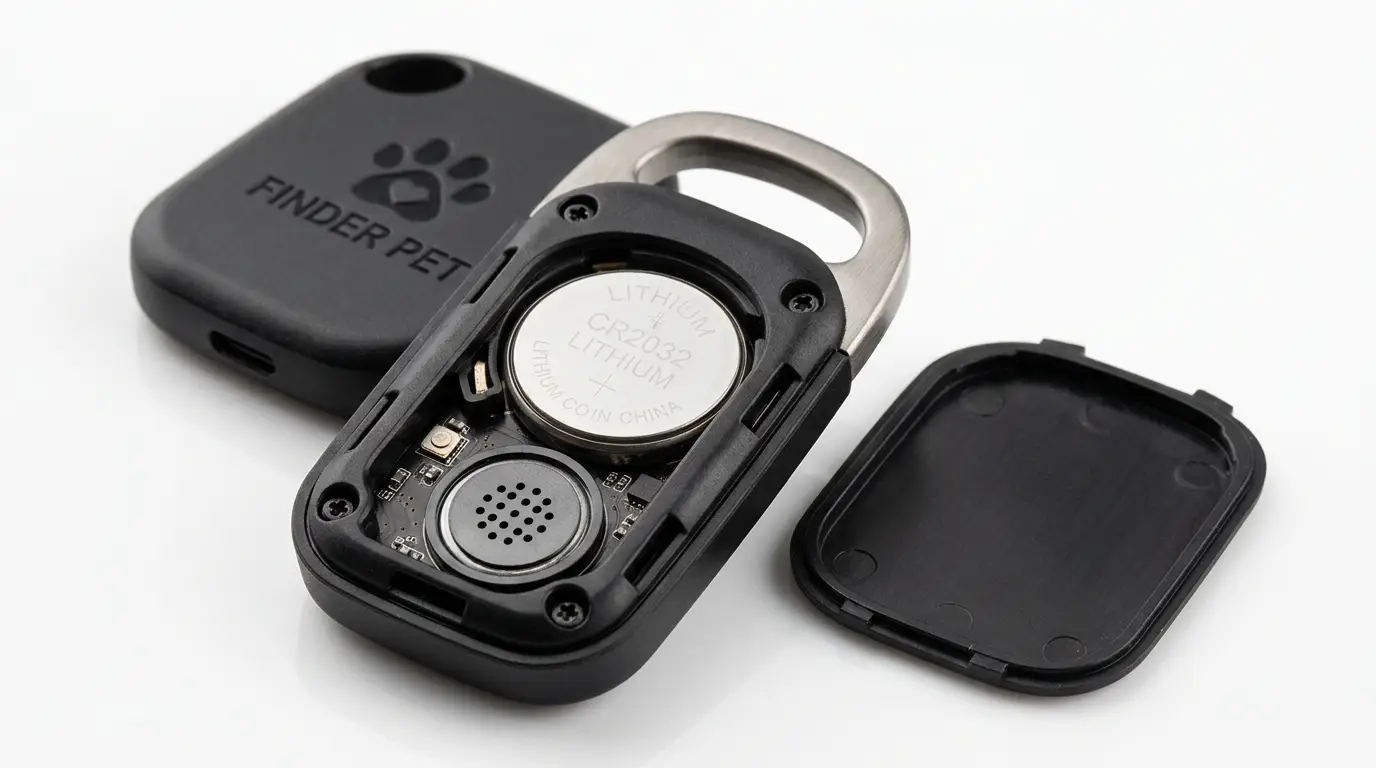
Bluetooth trackers like AirTag and Tile work on a completely different principle: they don’t track anything themselves. They rely on other people’s phones to do the heavy lifting.
- Bluetooth LE Chip (Nordic nRF52 series): Broadcasts a unique ID every few seconds. Range: 200-400 feet (Bluetooth 5.0).
- Speaker + Battery: A tiny piezo speaker for “find my tracker” chirping. Battery is usually user-replaceable CR2032 coin cell.
- No GPS, No Cellular: The tracker itself has no idea where it is. It’s just screaming “I’m here!” and hoping a passing phone picks up the signal and reports the location.
BOM Reality: A Bluetooth tracker costs $3-5 in components. The entire business model hinges on massive network effects — millions of phones running the Find My network. Apple has this. Tile… struggles.
| Hardware Spec | GPS Tracker | Bluetooth Tracker |
|---|---|---|
| Location Source | Satellite + Cell Tower | Passing Phones |
| Range | Unlimited (with cell) | 200-400 ft |
| Monthly Fee | $5-10/month | $0 |
| Device Size | Larger (30-50g) | Tiny (10-15g) |
| Battery Life | 1-14 days (GPS active) | 6-12 months |
| Works Offline? | No (needs cell) | Limited (needs nearby phone) |
Part 2: Real-World Scenario Testing
Specs on paper mean nothing if the tracker fails when you need it most. Let’s run through three scenarios that expose the real differences.
Scenario 1: Dog Hiking in the Mountains
Your Golden Retriever catches a scent and disappears into the woods. You’re 3 miles from the trailhead with spotty cell coverage.
GPS Tracker Result
- Tractive/Fi: Updates every 2-60 seconds depending on subscription tier. Shows last known position even if signal drops temporarily.
- Limitation: If you’re in a true dead zone (no cell towers), the tracker can’t report. But it will buffer locations and sync when signal returns.
- Verdict: Worth the subscription fee for peace of mind in wilderness areas.
Bluetooth Tracker Result
- AirTag/Tile: Completely useless. No phones passing by in the wilderness means no location updates.
- Best case: You get a ping when someone eventually finds your dog and their phone picks up the signal.
- Verdict: Not designed for this scenario. Don’t rely on Bluetooth for off-leash adventures.
Scenario 2: Indoor Cat Escapes to the Neighborhood
Your indoor cat slips out the back door and you can’t find her within a 3-block radius.
GPS Tracker Result
- Tractive CAT Mini: Works well if the cat is outdoors. 1.4oz is lightweight enough for most cats.
- Limitation: GPS doesn’t work indoors. If your cat is hiding in a neighbor’s garage, you’ll only see the last outdoor position.
- Battery drain: Cats that hide a lot = more time searching = faster battery drain.
Bluetooth Tracker Result
- AirTag: Surprisingly effective in dense urban/suburban areas. Apple’s Find My network has millions of iPhones.
- Limitation: Updates only when a phone passes within range. Could be minutes or hours between pings.
- Verdict: Good enough for neighborhood cats if you have iPhone users nearby.
Scenario 3: Apartment Dog in a High-Rise
Your small dog lives in a 20-story apartment building. Walks are structured, supervised, and limited to the block.
GPS Tracker Overkill
- Why it’s wasteful: You’re paying $60-120/year for tracking you’ll rarely need. Your dog is always on leash, always supervised.
- Battery annoyance: Weekly charging for “just in case” protection.
- Verdict: Only worth it if you travel with your pet or have escape concerns.
Bluetooth Tracker Sweet Spot
- Perfect fit: Tiny, no subscription, battery lasts a year. Slip it on the collar and forget about it.
- Safety net: If your dog ever bolts, the dense urban network means fast location updates.
- Verdict: The right tool for apartment pets that stay close to home.
Part 3: The Subscription Trap (3-Year Cost Breakdown)
Pet tracker reviews love to hide the real cost. Let’s do the math.
GPS Tracker: 3-Year Total Cost
- Device (Tractive GPS DOG): $49.99
- Subscription (Basic): $5/month × 36 months = $180
- Subscription (Premium): $8/month × 36 months = $288
3-Year Total:
$230 – $338
(Basic vs Premium tier)
Bluetooth Tracker: 3-Year Total Cost
- Device (Apple AirTag 4-pack): $89 (or $29 single)
- Subscription: $0
- Battery replacements: $2/year × 3 = $6
3-Year Total:
$35 – $95
(Single vs 4-pack)
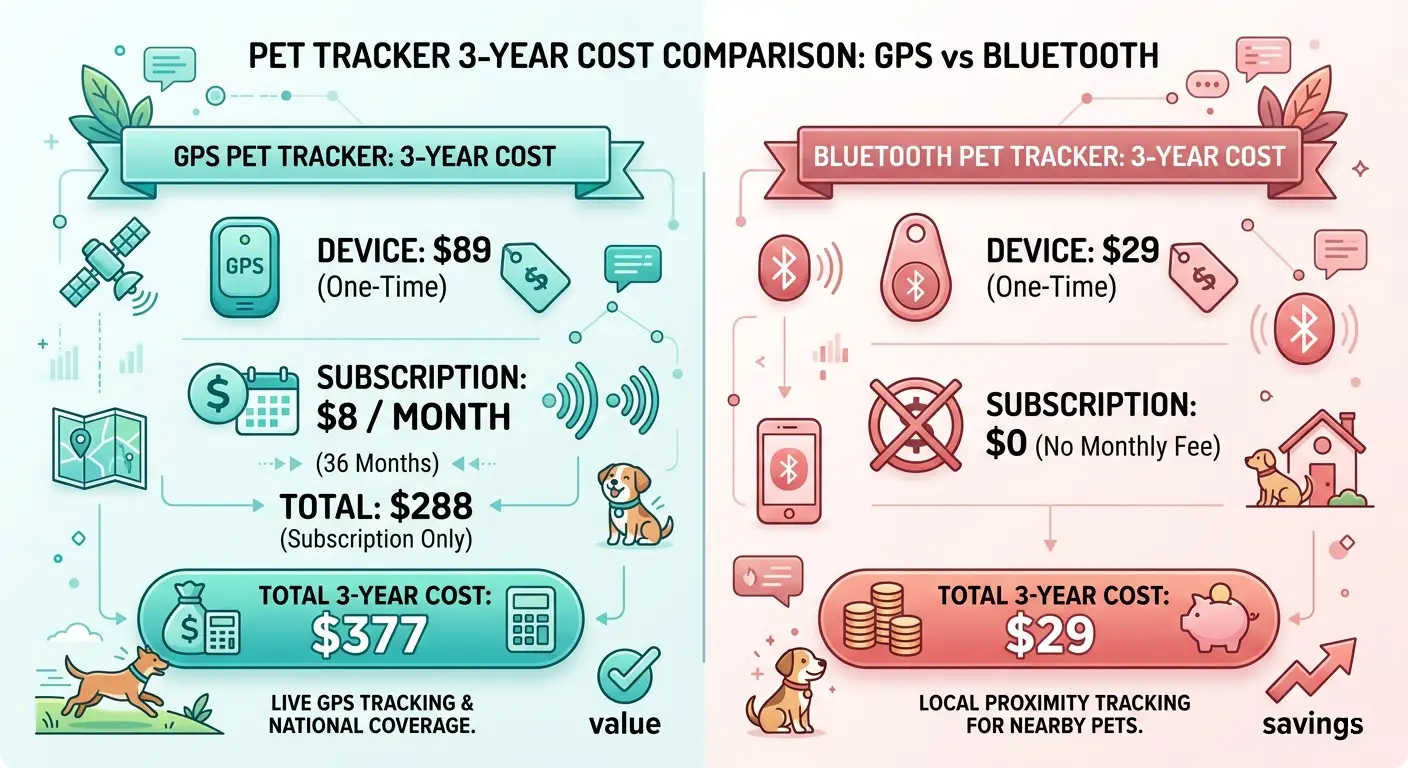
The Hard Numbers: Over 3 years, a GPS tracker costs 3-9x more than a Bluetooth tracker. That’s the price of unlimited range and real-time tracking. Is it worth it? Only you can decide based on your pet’s actual behavior.
Part 4: Decision Checklist
Stop guessing. Answer these questions honestly:
The 5-Question Test
1. How far does your pet typically roam?
- → More than 500ft from home: GPS required
- → Less than 500ft / stays indoors: Bluetooth sufficient
2. Does your pet go off-leash or hiking?
- → Yes: GPS (non-negotiable)
- → No: Bluetooth is fine
3. Are you willing to pay $60-120/year for tracking?
- → Yes: GPS is an option
- → No: Bluetooth only choice
4. Do you live in a dense urban/suburban area?
- → Yes (good Find My coverage): Bluetooth works well
- → No (rural/remote): GPS or nothing
5. What’s your phone ecosystem?
- → All Apple: AirTag is seamless
- → Mixed/Android: Tile or Samsung SmartTag
- → Doesn’t matter: GPS works with any smartphone
The Hard Truth About GPS vs Bluetooth Pet Trackers
What Marketing Won’t Tell You
- Bluetooth is not “real” tracking. It’s crowd-sourced location reporting. If no phones pass by, you get nothing. In rural areas or at night, this can mean hours of silence.
- GPS doesn’t work indoors. If your pet is hiding in a basement or garage, GPS will show the last outdoor position. For indoor tracking, you need Wi-Fi-enabled devices (like Fi’s home beacon).
- “Health monitoring” features are mostly fluff. Step counting and sleep tracking on pet trackers are not medical-grade. Fun to look at, but don’t make decisions based on them.
- Neither technology works in true dead zones. No cell + no passing phones = no location. For deep wilderness, you need satellite communicators or VHF radio trackers like Garmin Alpha.
- The best setup might be both. GPS for active tracking, Bluetooth as backup in case the GPS battery dies or the device falls off.
Final Verdict: Which Technology Should You Choose?
-
1. Your dog hikes, camps, or goes off-leash.
GPS Required -
2. You live rural with sparse cell coverage but want tracking.
GPS Required -
3. Your pet stays within a few blocks of home.
Bluetooth OK -
4. You refuse to pay monthly subscription fees.
Bluetooth Only -
5. You want maximum safety redundancy.
Both (GPS + Bluetooth)
My Recommendation:
For most suburban dog owners, a GPS tracker like Tractive is worth the subscription. For indoor cats and apartment dogs, an Apple AirTag provides solid backup without ongoing costs. If your pet is a serious escape risk or goes on adventures, get both.
Frequently Asked Questions
Can I use a Bluetooth tracker for an outdoor cat?
Not recommended. Outdoor cats roam beyond the 200-400ft Bluetooth range and often pass through areas with sparse phone traffic. A GPS tracker like the Tractive CAT Mini is designed for this use case.
Do GPS trackers work without cell service?
No. GPS trackers need cellular networks to report location to your phone. In true dead zones, they can’t transmit. However, most will buffer locations and sync when signal returns. For off-grid tracking, consider satellite communicators or VHF radio trackers.
Can I use both GPS and Bluetooth trackers together?
Absolutely. Many pet owners use a GPS tracker for primary tracking and an AirTag as backup. If the GPS battery dies or the device malfunctions, the Bluetooth tracker provides a secondary safety net. It’s redundancy for peace of mind.
Which Bluetooth tracker works with Android?
Tile works with both iOS and Android. Samsung SmartTag only works with Samsung Galaxy devices. Apple AirTag requires an iPhone for setup and full functionality (Android users can only detect unknown AirTags, not track their own).
Why do GPS trackers require subscriptions?
The subscription covers cellular data costs. GPS trackers use LTE-M or NB-IoT networks to transmit location data, and carriers charge for this connectivity. The hardware itself is often sold at thin margins — the real profit is in the subscription.

Hi, I’m Lewis Lee.
I spent over 10 years in Shenzhen sourcing PCBA modules, testing antennas, and auditing electronics factories. I started PawsWired to cut through the marketing fluff and bring real, component-level teardowns to the pet tech industry. If a product cuts corners on safety, I’ll show you exactly where.