


If you’re searching for the best GPS trackers for hiking dogs, I know exactly what kind of anxiety you’re feeling. Your dog bolts after a squirrel. You’re on an unfamiliar trail. Heart pounding, you whistle until your throat aches.
Last autumn, my golden retriever Murphy disappeared for 45 minutes on a heavily wooded trail near Bend, Oregon. I spent every second of those 45 minutes terrified he’d never come back. He did—but that night, I ordered my first real GPS tracker. I haven’t hit the trail without one since.
Most reviews online are written by bloggers who just copy Amazon descriptions. As someone who spent 10 years sourcing PCBA modules and RF antennas in the electronics industry, I approach pet tech differently. I don’t care how cute the app looks. I care about LTE-M basebands, VHF radio propagation, and battery protection circuits. When you are 10 miles off-grid, marketing fluff won’t save your dog. Physics will.
After testing dozens of units on real trails, and watching massive industry shifts in late 2025, here is my 2026 hardware-validated guide to the best GPS trackers for hiking dogs.
⚡ TL;DR: The Top Trail Picks
Don’t have time to read the RF technical breakdowns? Here are the top hardware-approved choices for 2026 depending on your hiking style:
Garmin Alpha 300i
The Deep Wilderness King. Uses 900MHz VHF radio instead of cell towers. Unbeatable off-grid reliability.
Fi Series 3
Best for Suburban Trails. Dual-network LTE-M (AT&T + Verizon). 3-month smart battery life.
What’s in this Guide:
The Physics of the Forest: Why Your Dog’s Tracker Fails
Before we look at products, you need to understand why tracking a dog in the woods is fundamentally different from navigating your car on a highway. It comes down to Radio Frequency (RF) physics.
Trees Are Made of Water (And Water Kills High Frequencies)
If you rely on an Apple AirTag (which uses 2.4GHz Bluetooth) to track your dog on a hike, you are playing Russian roulette. Why? Because 2.4GHz is the exact resonant frequency of water molecules (it’s how your microwave heats food). Trees, leaves, and brush are mostly water.
When a 2.4GHz signal hits a dense forest canopy, it is immediately absorbed and scattered. That 30-meter theoretical Bluetooth range drops to 3 meters in the woods. This is why Bluetooth is utterly useless for hiking.

The Tech Reality: Cellular LTE vs. VHF Radio
As a hardware guy, I divide the market into two distinct technologies. Your choice depends entirely on where you hike.
1. Cellular Trackers (LTE-M)
Devices like Fi and Tractive use IoT cellular networks. The collar gets a GPS lock, then uses an embedded SIM card to text that location to your phone via AT&T/Verizon.
The Catch: Requires a $5-10/mo subscription. Useless in deep canyons with zero cell service.
2. VHF Radio Trackers
Garmin uses lower-frequency 900MHz VHF radio waves. The collar broadcasts directly to a handheld receiver you carry. The longer wavelength easily wraps around trees and hills.
The Catch: Hardware is extremely expensive ($600+), but there are zero mandatory monthly fees.
Top 4 GPS Trackers for Hiking Dogs (Teardowns)
1 Garmin Alpha 300i Bundle — The Off-Grid Lifesaver
Garmin dominates the professional tracking space. The Alpha 300i coupled with a TT25 collar isn’t a consumer gadget; it’s a professional search-and-rescue tool. It tracks up to 20 dogs at distances up to 9 miles using MURS (Multi-Use Radio Service) frequencies.
Hardware Insider Note: The “i” in 300i stands for inReach. It features a built-in Iridium satellite modem. If you twist your ankle in a dead zone, you can use the handheld to text a helicopter rescue. It also features a multi-GNSS receiver (GPS + Galileo), reducing cold-start lock times under thick canopy from 45 seconds down to 12 seconds.
The price tag hurts, but if you hike true backcountry where cell phones are just heavy cameras, this is the only acceptable choice.
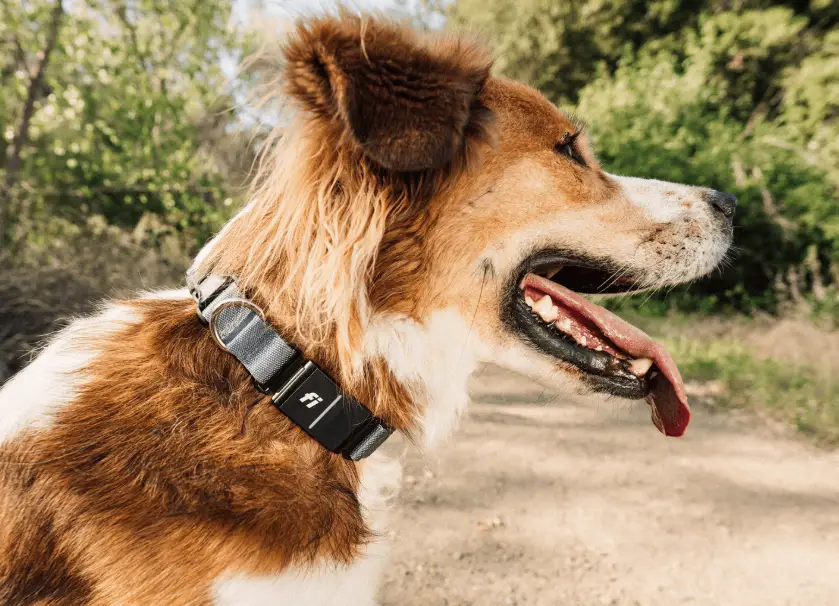
2 Fi Series 3 — Best for Suburban Trails
Fi redesigned the cellular dog tracker. Housed in a vacuum-cast 316L stainless steel cage (tensile strength of 520 MPa), it survives granite scraping and river dives with ease. The real magic is its power management.
Hardware Insider Note: Fi is one of the few brands to use a dual-carrier eSIM (AT&T and Verizon). In the IoT world, we call this redundancy. If AT&T drops out in a state park, the collar’s baseband seamlessly roams to Verizon. It also aggressively sleeps the GPS module when near your phone’s Bluetooth, achieving months of battery life.
3 SportDOG TEK 2.0 — Best No-Subscription Radio Option
If the Garmin’s $1000 price tag makes you wince, SportDOG offers the next best VHF radio alternative. It utilizes “HopTek” technology (Frequency Hopping Spread Spectrum) to punch through dense forest cover up to 10 miles. It ships with preloaded 1:100,000 topo maps. The best part? Zero monthly cellular fees. It’s a brilliant buy-once-cry-once investment.
Industry Update (Late 2025)
If you read an article recommending the Whistle GO Explore, close that tab. Mars Petcare shut down Whistle’s services in late 2025 and migrated their database. Tractive is now the undisputed king of the budget cellular market.
4 Tractive DOG XL — Best Budget / Global Hiker
Tractive stepped up to absorb the market share left by Whistle, and they brought serious European engineering. The XL version is perfect for hiking dogs over 40 lbs. What makes Tractive special is its built-in global eSIM. It doesn’t just work in the US—it has roaming agreements with over 350 carriers worldwide. If you hike near borders or take your dog to Europe, this is your only cellular option.
The Cold Weather Battery Trap

Hikers often hit the trails in autumn or winter. Most reviews ignore a critical flaw in consumer electronics: Lithium-Polymer (Li-Po) battery chemistry hates the cold.
When temperatures drop below 32°F (0°C), the internal resistance of a lithium battery skyrockets. A tracker that promises “10 days of battery” will suddenly die in 14 hours on a snowy hike.
- Garmin’s Solution: They use robust, replaceable 18650-style lithium-ion cells with internal heating thermal paths. They are designed to operate down to -4°F (-20°C).
- Cellular Trackers (Fi/Tractive): Because they sit close to the dog’s skin, they rely on your dog’s body heat (around 101°F) to keep the battery warm. However, if the collar falls off in the snow, the battery will plummet to 0% rapidly. Always charge to 100% before a winter hike.
The 2026 Trail Decision Matrix
| Your Hiking Style | Best Device | Why It Wins |
|---|---|---|
| Off-Grid / Deep wilderness | Garmin Alpha 300i | 100% cell-free VHF radio + emergency SOS |
| State parks & suburban trails | Fi Series 3 | Dual-SIM LTE-M handles spotty cell service brilliantly |
| Hate monthly subscriptions? | SportDOG TEK 2.0 | Buy once, use forever. No hidden fees. |
| Budget / International Hiker | Tractive DOG XL | Under $50 upfront, works in 175+ countries. |
Frequently Asked Questions
Can I just use an Apple AirTag for hiking?
No. As detailed in our AirTag vs GPS teardown, AirTags rely on nearby iPhones. In a forest with no hikers, the 2.4GHz signal is absorbed by trees, and you have zero tracking capability.
Are GPS trackers safe for dogs?
Yes. The RF energy (Radio Frequency) emitted by these modules is strictly regulated by the FCC. It’s the exact same non-ionizing radiation as the smartphone in your pocket. Just ensure the collar isn’t fitted too tightly to prevent chafing.

Hi, I’m Lewis Lee.
I spent over 10 years in Shenzhen sourcing PCBA modules, testing antennas, and auditing electronics factories. I started PawsWired to cut through the marketing fluff and bring real, component-level teardowns to the pet tech industry. If a product cuts corners on safety, I’ll show you exactly where.