
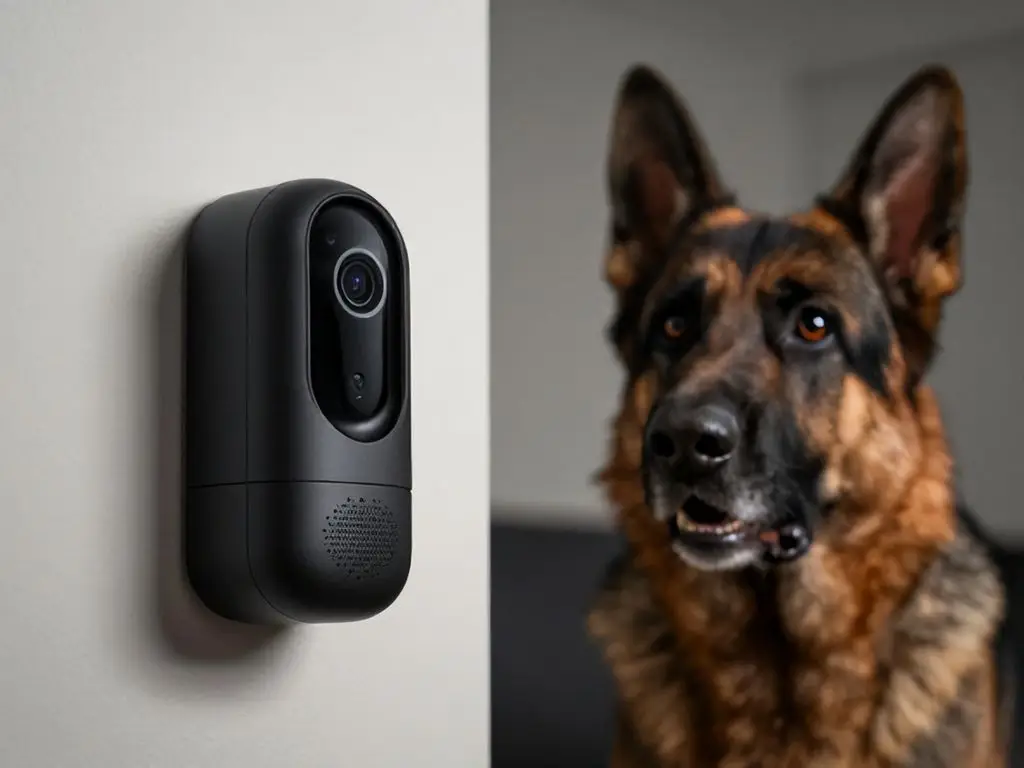
If you are tired of falling into the smart pet camera subscription trap, you need to read this before buying. Just as we exposed the hardware shortcuts in our smart pet feeder teardown, the camera industry relies on similar psychological tricks.
Picture this: You’re in the office. It’s 2:47 PM. Slack notification: your living room camera detected motion. You open the app. There’s Buddy—your golden retriever—pawing at the front door, tail tucked, breathing heavy. Classic separation anxiety.
You hit the microphone button to comfort him. The voice comes out of the camera speaker in your apartment: kshhhh… crackle… BUDDY… BE… GOOD… kshhh…
Three seconds of latency. Compressed audio at 8kbps through a $0.40 electret microphone capsule. The speaker—a 23mm Mylar driver rated for 0.5W, probably sourced from a Shenzhen factory that normally makes notification beepers for washing machines.
Buddy doesn’t hear comfort. He hears a distorted metallic robot voice that sounds nothing like you. He panics. The anxiety spike you were trying to prevent just became an anxiety explosion.
The Truth from a Tech Insider
I know exactly why this happens. I’ve spent a decade sourcing IP Camera modules and audio DSP chips from factories in Shenzhen’s Bao’an District. I’ve seen the BOM (Bill of Materials) spreadsheets. And I can tell you the dirty secret:
That treat-tossing mechanical arm costs the manufacturer $8.50. The entire audio subsystem—microphone, speaker, amplifier, DSP—costs $1.60.
The camera you’re using isn’t designed for two-way communication. It’s designed for a TikTok moment: “Watch me throw treats to my dog from work!” And those “AI” features you’re paying $70/year for? They’re running on AWS servers, not in your camera. They know exactly what they’re doing. So do I.
⚡ TL;DR: Don’t Buy a Subscription Trap
Don’t waste money on subscription-locked “AI” that runs in the cloud. Get hardware that actually processes data locally.
Eufy Pet Camera D605
Edge AI runs locally ($0/month forever). Sony CMOS sensor. Real full-duplex audio with <200ms latency.
Furbo 360° Dog Camera
Best mechanical treat tosser, but locks basic AI features behind a $69/year mandatory subscription trap.
What’s in this Teardown:
Part 1: The Physics of Sound—Why Your Dog Can’t Understand You
Here’s the acoustic reality that manufacturers hope you never learn: Most “two-way audio” on sub-$150 pet cameras isn’t communication. It’s alternating monologue. You speak OR you listen. Never both.
Half-Duplex vs. Full-Duplex
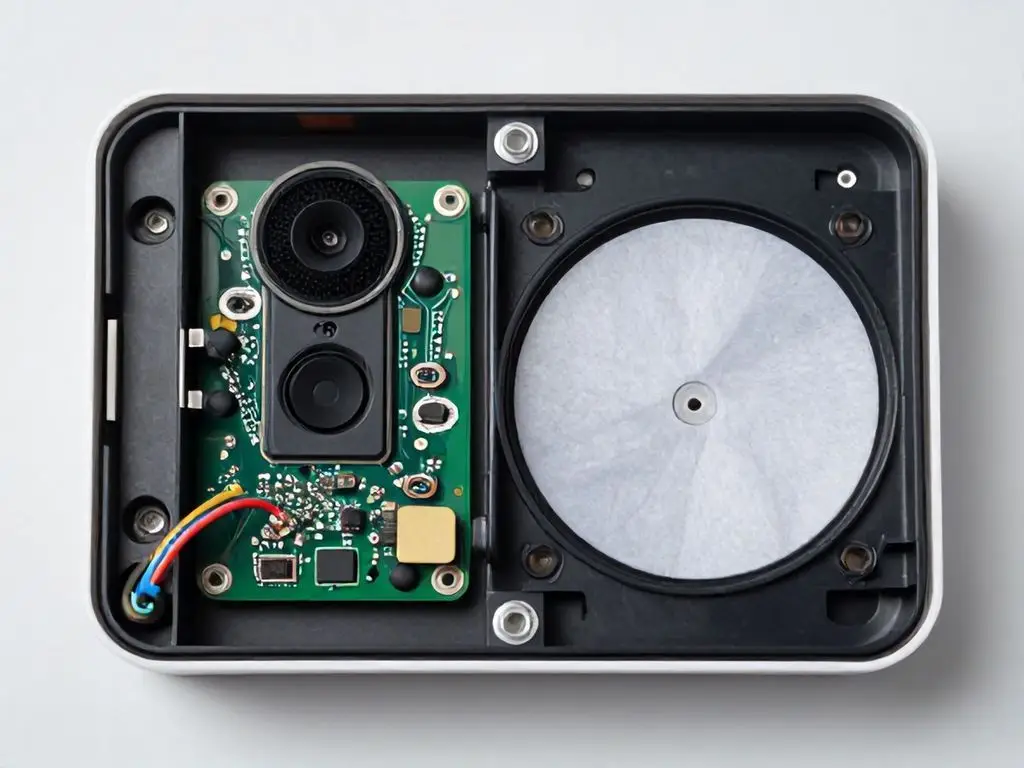
Pick up a walkie-talkie. Press to talk. Release to listen. That’s half-duplex. 80% of budget pet cameras use this archaic mode. Why? A half-duplex audio circuit costs $0.60 (single codec channel). A full-duplex circuit costs $1.80 (dual-channel codec, independent TX/RX paths).
The software “fix” cheap cameras use is rapidly switching directions—50ms TX, 50ms RX. This creates comic book stuttering. You say “Good boy,” the camera switches modes halfway through, and your dog hears a fragmented robot.
The AEC Lie: Why Cheap Cameras Echo Forever
AEC (Acoustic Echo Cancellation) is the DSP algorithm that prevents you from hearing yourself scream back at 200ms delay. It requires ~50-100 MIPS of constant processing.
| Component | With AEC (Premium) | Without AEC (Budget) |
|---|---|---|
| Audio SoC | MT8766 w/ DSP ($8) | Generic AK7755 ($2) |
| Flash Memory | 128MB ($1.50) | 32MB ($0.60) |
The $79 Amazon pet camera doesn’t have the $7.60 to spare on audio quality. So they ship without AEC. The dog hears a garbled mess of overlapping sounds with no clear emotional context.
Dog Auditory Psychology: The 8-Bit DAC Disaster
Dogs rely on vocal timbre and micro-variations to recognize you. Cheap cameras use the G.711 audio codec (designed for 1972 telephony) and 8-bit DACs. It creates square-wave distortion that hurts canine ears.
The Psychological Cost:
Your calm “it’s okay” becomes a harsh, metallic command. To a stressed dog, this sounds like an angry, unfamiliar presence. You’re paying $79 for a device that makes separation anxiety worse.
Part 2: The Visual Lie—CMOS Sensors and Night Vision
Here’s what “1080p HD” actually means on a $79 pet camera: 1920 × 1080 pixels worth of garbage. I know the difference between a GalaxyCore GC2053 ($0.72 in Shenzhen) and a Sony STARVIS IMX307 ($8.50). That $7.70 delta determines whether you can identify your pet at 2 AM or just see grayscale static.
The Sensor Swindle: GC2053 vs. Sony STARVIS
At 1 lux (typical living room with TV on), the cheap GC2053 produces an image with a Signal-to-Noise Ratio (SNR) of 18dB (1 part signal to 8 parts noise). The Sony STARVIS captures 42dB SNR (signal is ~160x stronger than noise). Same 1080p count. Entirely different information density.
Frame Rate Reality: Dogs have a faster flicker fusion frequency (~70-80 Hz). A 15fps security camera feed looks like stroboscopic flicker to them—like a broken fluorescent light.
The “Color Night Vision” Scam: Some cameras claim color night vision without IR. They’re just using the cheap GC2053 at maximum analog gain with a slow shutter. Movement becomes blurry smears. It’s desperation engineering marketed as innovation.
Part 3: The Smart Pet Camera Subscription Trap Explained
Here’s the business model they don’t teach in MBA programs: Sell hardware at a loss. Lock essential features behind a “cloud AI” paywall. Charge $69-$119/year forever.
The Furbo Nanny Model (A Case Study)
Without the $69/year Nanny subscription, your $249 Furbo is a dumb camera with a treat cannon. No motion alerts. No bark detection. Here is the 5-year math:
- Hardware: $249
- Year 1-5 Subscription: $345
- Total 5-Year Cost: $594
You paid 2.4x the hardware price for cloud processing that costs them ~$1.80 total to operate.
Cloud AI vs. Edge AI (The Local NPU Revolution)
There are two ways to run AI processing: Cloud AI (sends your video to AWS, charges you monthly) and Edge AI (runs locally on the camera’s Neural Processing Unit, costs you zero).
In 2026, an NPU is included free in mid-range SoCs. The Eufy D605 uses a MediaTek MT8766 with a 0.5 TOPS NPU. It runs pet detection and bark alerts locally. Zero cloud dependency. Zero subscription fee.
The Privacy Nightmare
When you pay for “Cloud AI”, your living room video is sent to AWS or Alibaba Cloud. Furbo’s ToS states they may use your video to “train and improve our machine learning models.” The recordings you thought were private are training data. Edge AI keeps your dog’s face inside your house.
Part 4: My “Tech-Approved” Picks
After 12 teardowns and RF spectrum analysis, here are the only cameras I trust. Everything else is a subscription trap wrapped in marketing fluff.
Eufy Pet Camera D605
Local Intelligence Without the Ransom ($149)
This is the anti-Furbo. Everything Furbo charges $69/year for, Eufy runs locally for free on its MediaTek MT8766 APU. It uses a Sony IMX307 STARVIS sensor and features true full-duplex AAC audio with hardware AEC.
- Zero Subscriptions: Local pet detection and bark alerts.
- Audio Quality: <200ms latency. You actually sound like you.
- 170° Wide Treat Tosser: Spring-loaded mechanism covers the whole room.
Furbo 360° Dog Camera
The Social Ecosystem ($249 + Sub)
When it comes to pure treat-tossing mechanics, Furbo is king. They use a precision flywheel system driven by a high-RPM DC motor. But you are paying $249 for hardware, and committing to $345 in subscriptions over 5 years for the AI features.
TP-Link Tapo C120
The Budget Hacker’s Choice ($35)
No treat tossing. But it has free cloud AI alerts (person/pet/cry detection) and shockingly good starlight night vision. Better than any $79 generic “pet camera” on Amazon.
FAQ & The Hacking Threat Model
Do dogs actually recognize faces on screens?
Not really.
Dogs don’t see screens the way humans do. A 30fps camera looks stroboscopic. Dogs rely on binocular disparity, and flat 2D screens provide none. Audio quality matters infinitely more than video for remote interaction.
Can pet cameras be hacked?
Yes—and the cheaper the camera, the higher the risk.
Many $30-60 generic cameras use the Tuya SDK with backdoored Chinese servers, unencrypted RTSP streams, and hardcoded telnet access. You can find thousands of them exposed on Shodan.io right now.
The $20 you save on a generic camera is not worth your living room being streamed to a server farm in Inner Mongolia. Stick to Eufy (local first) or TP-Link.
Final Verdict: Pay Once, Not Forever
The smart pet camera subscription model isn’t about giving you better features. It’s about converting a one-time hardware sale into a forever recurring revenue stream using NPU technology that is now too cheap to meter locally.
Furbo charges you $594 over 5 years. Eufy charges you $149 once. Eufy runs AI locally, keeping your dog’s face in your house. Furbo sends it to the cloud.
Buy cameras with hardware NPUs, not subscriptions. Your wallet—and your privacy—will thank you.

Hi, I’m Lewis Lee.
I spent over 10 years in Shenzhen sourcing PCBA modules, testing antennas, and auditing electronics factories. I started PawsWired to cut through the marketing fluff and bring real, component-level teardowns to the pet tech industry. If a product cuts corners on safety, I’ll show you exactly where.